The Breton Stripe: Why the French Sailor Top Is the Most Timeless Piece You Can Own
Quick Answer: The Breton stripe is a navy-and-white French sailor top with a boat neck and a slightly boxy cut. It stays timeless because the stripe reads as a neutral with personality, and the shape works with denim, tailoring, and skirts alike. Buy one in substantial cotton with a classic cut and it’ll stay in rotation for a decade or more.
Some pieces cycle in and out of style every four years. The Breton has been quietly ignoring that cycle since the 1850s.
It shows up in photographs of fishermen, of artists, of film stars, and of your favorite person walking to the corner store — looking exactly right in all four contexts. That’s not an accident of taste. It’s structural.

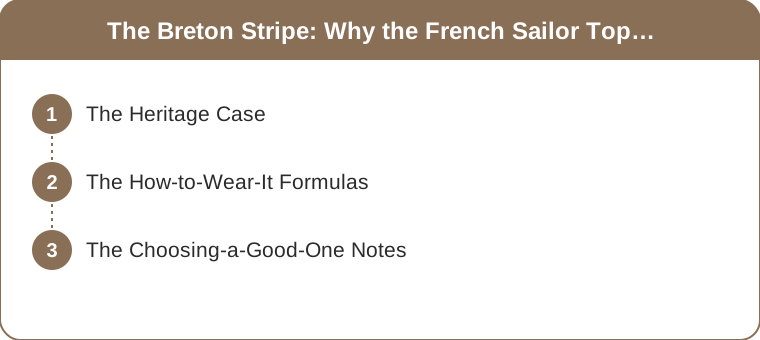
What Makes the Breton Stripe So Timeless?
Four things, and they reinforce each other.
It’s been chic for over a century. A piece that has looked right through every decade since the 1800s has already survived the test that kills trends. Nothing about it is pegged to a moment, so nothing about it can date.
It reads as French-girl shorthand. Fair or not, the Breton signals effortlessness — the sense of someone who got dressed in ninety seconds and looks better than you do. That association is doing quiet work every time you put one on.
It works across ages and occasions. A Breton is equally correct at 22 and at 62, at a school pickup and at a gallery opening. Very few garments manage that range.
And critically — a stripe behaves like a neutral. It adds interest without committing to a pattern statement. You can pair a Breton with almost anything you’d pair with a plain white tee, which is why it never feels like a “look” you have to plan around.

How Do You Wear a Breton Stripe?
Six formulas that cover essentially every occasion you’ll face.
- With denim and flats. The default and still the best. Straight-leg jeans, ballet flats, done in under a minute.
- Under a blazer. Navy or camel blazer over a Breton turns it into something you can wear to a meeting. Classic with a small edge.
- With a midi or slip skirt. The high-low move — a workwear-heritage top against something fluid. Reliably more interesting than either piece alone.
- With a red accent. A red lip, a red flat, a red bag. It’s the French tricolor nod and it lifts the whole outfit for zero effort.
- Layered under a trench or over a collar. A white shirt collar peeking out of a Breton is a five-second upgrade.
- Kept in the navy-and-white palette. Add white denim or navy trousers and the whole outfit reads deliberate.
The layering trick is the one people underuse — a collar under a Breton changes the register of the entire outfit and costs you nothing but the shirt you already own.

What Nobody Tells You About Buying a Breton
The differences between a $25 Breton and a $120 Breton are mostly invisible in photos and completely obvious after ten washes.
Fabric weight is the single biggest tell. A substantial cotton jersey holds its shape through the shoulders and doesn’t go transparent at the back. Hold it up to the light — if you can read your hand through it, it will look tired by spring.
The cut should be slightly boxy, not fitted. The authentic proportion is a little roomy through the body with a straight hem. A tapered, body-con Breton is a trend garment wearing a heritage costume, and it will date the way trend garments do.
The boat neck is not optional. That wide, shallow neckline is what makes the shape read as a Breton rather than a striped t-shirt. It’s also genuinely flattering, because it broadens the shoulder line and makes the waist look narrower by contrast.
Stripe proportion matters more than you’d think. The classic is a narrower navy stripe on a wider white ground. Even, thick stripes read more nautical-costume than French-effortless.
And the white will go grey if you let it. Wash Bretons with whites or on their own, skip the fabric softener that dulls cotton, and dry flat when you can. Five extra minutes of care is the difference between six years and two.
Mini FAQ
Is the Breton stripe still in style?
Yes — and that’s slightly the wrong question. The Breton has been continuously in style for over a century, which means it’s not really subject to being “in” or “out.” It’s one of the small number of pieces that outlives the trend cycle entirely.
What colors go with a Breton stripe?
Navy, white, denim blue, camel, khaki, and grey are the safest and most classic. Red is the traditional accent. Because the stripe functions as a neutral, it also handles black and forest green comfortably.
Are horizontal stripes unflattering?
Not in practice. The boat neck broadens the shoulder line, which makes the waist read narrower by comparison, and the slightly boxy cut skims rather than clings. Stripe width matters far more than stripe direction.
TL;DR:
- The Breton has been chic for 170+ years, so it can’t date the way trend pieces do.
- A stripe acts like a neutral — pair it wherever you’d pair a plain white tee.
- Six formulas cover everything: denim, blazer, midi skirt, red accent, layered, navy-and-white.
- Buy substantial cotton, a slightly boxy cut, a true boat neck, and classic navy-on-white stripe proportions.
- Wash it with whites, skip softener, dry flat — that’s what keeps it going for a decade.
One good Breton, chosen properly, is genuinely a buy-once piece. Very few things in a wardrobe earn that.
Keep Reading
This article is for general styling and informational purposes only. Trends, sizing, availability and pricing may vary by brand and season.