Why a Scarf Changes the Proportions of a Classic Coat
Quick Answer: A scarf adds volume at the highest point of an outfit, so it shortens the visible neck and moves the eye upward, which makes a long coat look longer and a short coat look shorter and heavier. The reliable rules are to match the bulk of the scarf to the weight of the coat, keep the ends either well above the hem or hanging long and narrow, and leave some neck showing when the coat has a collar. A bulky scarf inside a structured collar is what makes a good coat look crumpled.
You put on the coat and it looks right. You add the scarf you have worn all autumn and something goes slightly wrong, and you cannot say what. It is almost never the colour. It is that the scarf has moved the balance of the whole outfit about fifteen centimetres upward.
What does a scarf actually do to the line of a coat?
It adds mass at the top, and mass at the top changes everything below it.
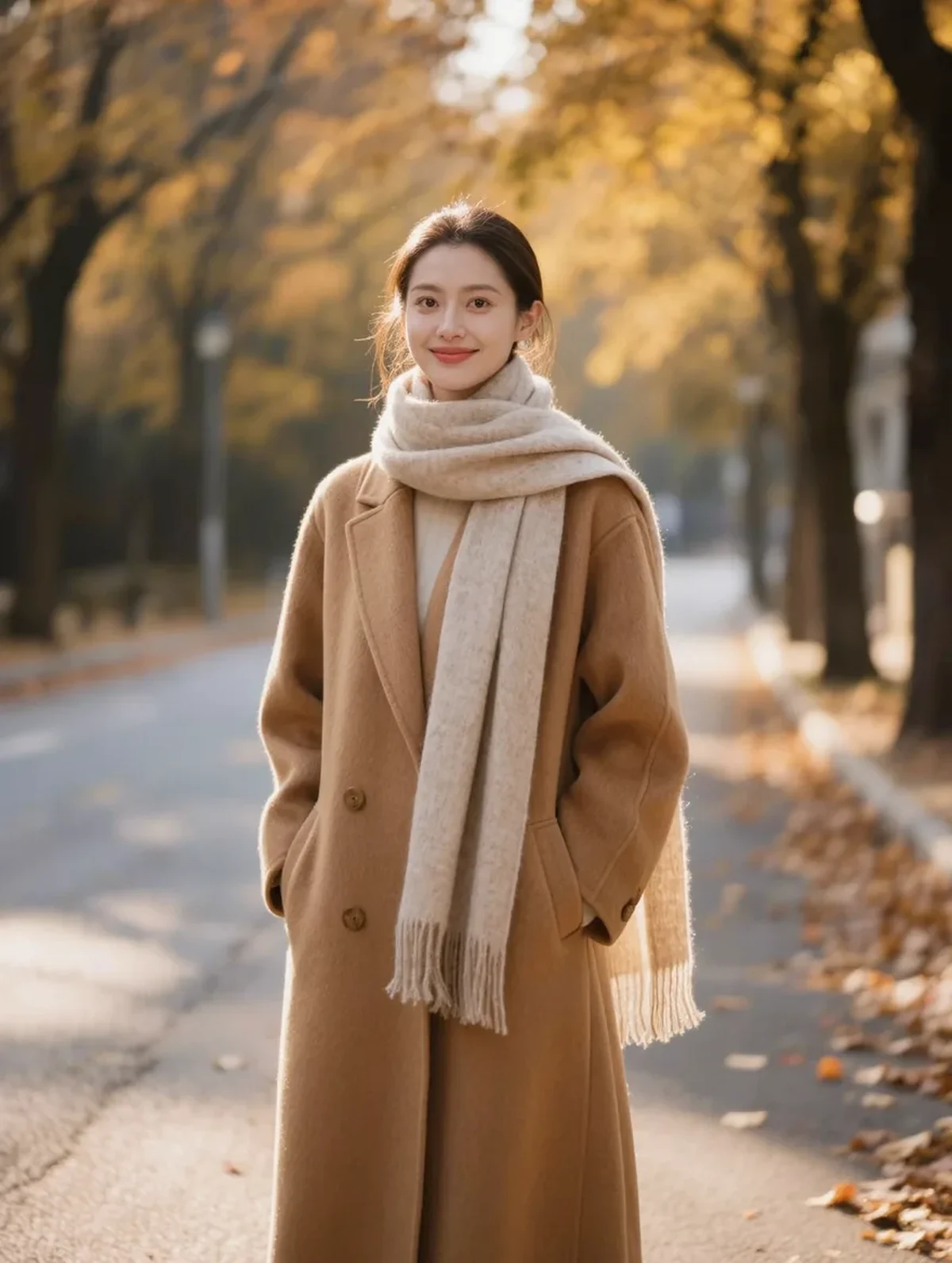
A coat reads as a vertical line from shoulder to hem. A scarf interrupts that line at the neck, which does three things. It makes the shoulders look wider and more rounded. It shortens the visible neck, sometimes dramatically. And it draws the eye upward, so the length below the interruption reads as one long stretch.
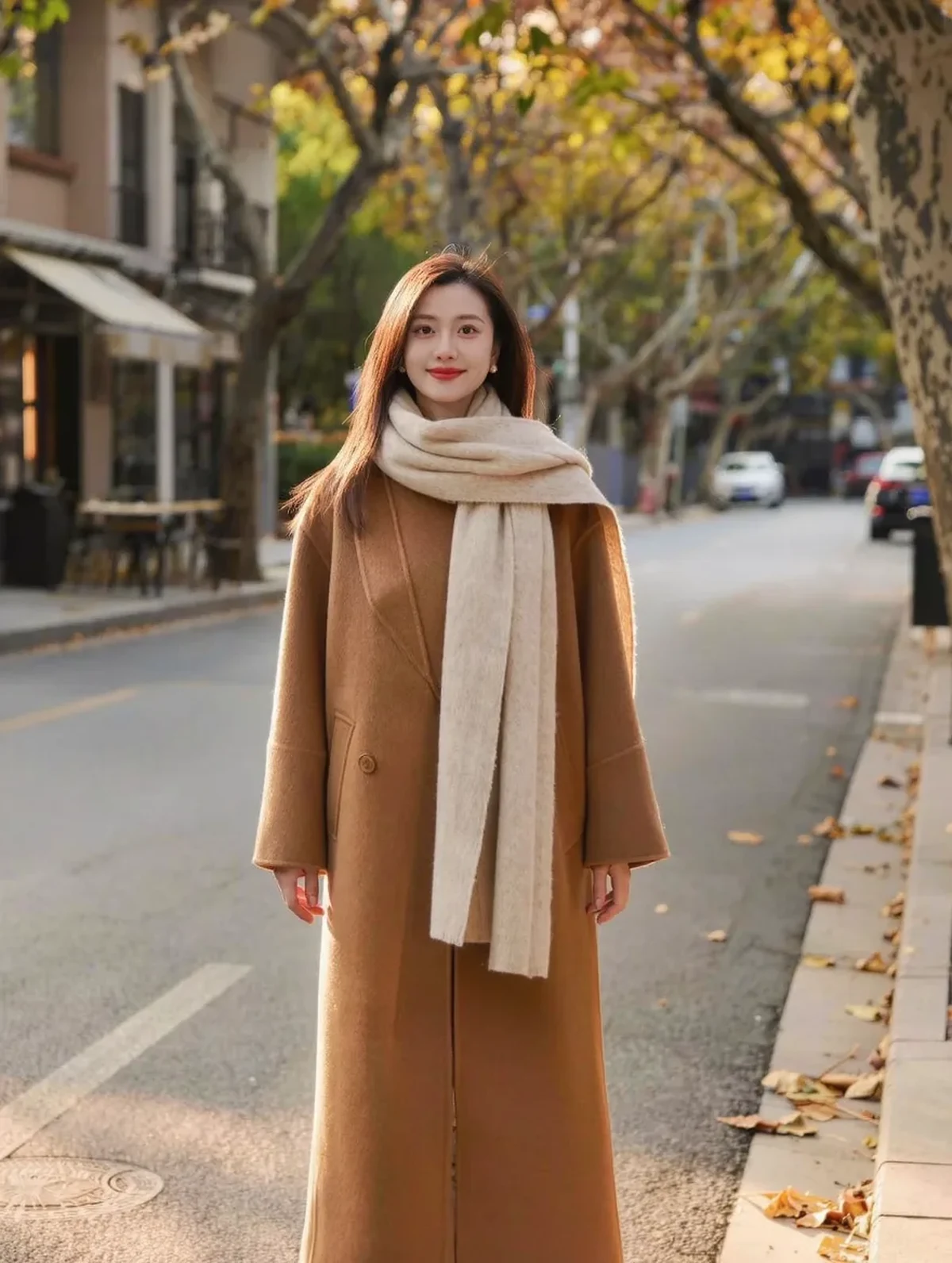
On a long coat that is generally flattering — the eye starts high and travels down an uninterrupted column, which is why scarves and long coats are such a durable combination.
On a short or cropped coat it works against you, because the mass at the neck and the hem at the hip crowd into the same area. The result reads as top-heavy, and adding a bulkier scarf makes it worse rather than warmer-looking.
The volume has to be proportional to the coat’s weight. A chunky knit scarf on a fine wool coat looks borrowed from a heavier outfit. A thin silk scarf inside a heavy overcoat disappears and adds nothing but a stripe of colour. Matching the apparent weight of the two is the single adjustment that makes most scarf problems go away.
And length matters as much as bulk. Ends that stop somewhere in the middle of the coat create a second horizontal exactly where you do not want one. Ends that hang below the hip, or ends tucked away entirely, both read as intentional.
How should a scarf sit with different collars?
The collar is the part people ignore, and it decides how a scarf can be worn.
A notched or structured collar — on a classic wool coat or a blazer — is designed to sit flat and frame the neck. Cramming a bulky scarf inside it forces the collar outward and breaks the line the tailoring was built for. A flat scarf worn under the collar and lying smooth, or a slim scarf tied close, keeps the collar intact.
A stand collar or funnel neck has no lapel to disturb, so it tolerates volume well. This is where a chunky knit sits naturally, filling the opening rather than fighting it.
A trench coat is the awkward case, because it has a structured collar that is meant to be worn both up and down. With the collar down, keep the scarf slim. With the collar up, a loosely looped scarf inside it looks deliberate, and it is one of the few places a soft scarf and a structured collar genuinely work together.
A collarless or round-neck coat is the most forgiving of all and takes almost any scarf, which is why collarless coats photograph so well in autumn styling.
And leave some neck visible whenever the coat has a collar. A scarf that swallows the neck entirely makes the head look set directly on the shoulders, and it is the difference between looking wrapped up and looking bundled.
What Nobody Tells You About Scarves
The fold is a volume control. A large square or a wide rectangle folded twice sits half as bulky as one folded once. If a scarf you like is too bulky for a coat you like, the fix is usually folding rather than replacing.
A scarf hides the one thing a coat is judged on. Across a room a coat is a shoulder line, a length and a colour — and a big scarf obscures the shoulder line entirely. If you have a coat with a beautiful shoulder, a slimmer scarf shows it. If you have a coat whose shoulder is slightly wide, a fuller scarf helpfully disguises it.
Cashmere behaves differently from lambswool at the same thickness. Cashmere drapes and collapses; lambswool holds its shape and stands. Two scarves of identical weight can look completely different around a neck, and this is why a cashmere scarf reads as quiet and a lambswool one reads as substantial.
Fringe is a horizontal. A heavily fringed end creates a visible line where it falls, so it wants to land somewhere deliberate — above the waist or below the hip, rarely in between.
And a scarf worn indoors is a different garment. Without the coat, the same scarf becomes the heaviest thing in the outfit. The people who look effortless with scarves are mostly people who take them off at the door.
Which scarf works with which coat?
A long wool overcoat takes almost anything, and looks best with a long scarf hanging straight down on both sides or looped once. The vertical ends reinforce the coat’s own line. This is the easiest combination in autumn dressing and hard to get wrong.
A short or cropped jacket wants a slim scarf, tied close and small. Volume at the neck plus a hem at the hip compresses the whole outfit.
A belted coat has its own strong horizontal at the waist, so scarf ends should either finish clearly above the belt or fall well below it. Ends that land on the belt create a visual pile-up at exactly the point the belt is trying to define.
A double-breasted coat already has visual weight across the chest from the button arrangement, so a narrower scarf keeps it from becoming busy. Save the largest scarf for a single-breasted coat with a plain front.
And a fine or lightweight coat needs a scarf of similar weight. This is the mismatch that appears most often in early autumn, when the coat has come out but the winter scarf is the only one to hand — a mid-weight scarf in a lighter fibre bridges the six weeks between seasons better than either extreme.
FAQ: Scarf and Coat Questions, Answered
Should the scarf match the coat or contrast with it?
Either works, but they do different jobs. A scarf close to the coat’s colour extends the vertical line and makes the whole outfit read taller. A contrasting scarf creates a deliberate focal point at the face, which is flattering but shortens the line. Choose by which effect you want rather than by a rule.
Is there a length that works for everything?
A scarf roughly as long as you are tall is the most versatile, because it can be looped twice for volume or hung straight for length. Much shorter limits you to one arrangement; much longer needs a long coat to balance it.
What about wearing a scarf under the coat rather than over it?
Under the coat, with the collar closed over it, is warmer and far slimmer, and it is the standard approach in genuinely cold weather. It also removes every proportion problem discussed here, which is worth remembering on the days when you would rather not think about any of this.
TL;DR:
- A scarf adds mass at the top of an outfit, which flatters a long coat and crowds a short one.
- Match the scarf’s apparent weight to the coat’s, and fold a bulky scarf smaller rather than replacing it.
- Keep volume out of a structured collar, and leave some neck showing whenever the coat has one.
- Let the ends fall clearly above or below the waist — never landing on a belt or in the middle of the coat.
Scarves get chosen for colour and warmth and then quietly decide how the whole coat looks. Spend one morning trying the same coat with three different scarves in a full-length mirror; the difference is larger than anyone expects, and after that you will never reach for the wrong one again.
Keep Reading
This article is for general styling and informational purposes only. Trends, sizing, availability and pricing may vary by brand and season.