Why Buttons Tell You More About a Garment Than the Label
Quick Answer: Buttons reveal cost decisions the fabric hides. Check three things: material (horn, corozo and mother-of-pearl cost several times what polyester does), attachment (cross-stitched with a shank, not a flat four-hole blob), and spares (a garment supplied with a spare button was costed properly). Uneven natural variation in a button is a good sign; perfect uniformity usually means moulded plastic.
Everyone checks the fibre content. Almost nobody checks the buttons — which is exactly why the buttons are honest.
A brand can put a good fabric on a badly made garment, because fabric is what the customer touches in the shop. Buttons are decided by a costing spreadsheet, late in the process, and they tell you what that spreadsheet looked like.
Eight seconds at the cuff will tell you more than the label on the neck.
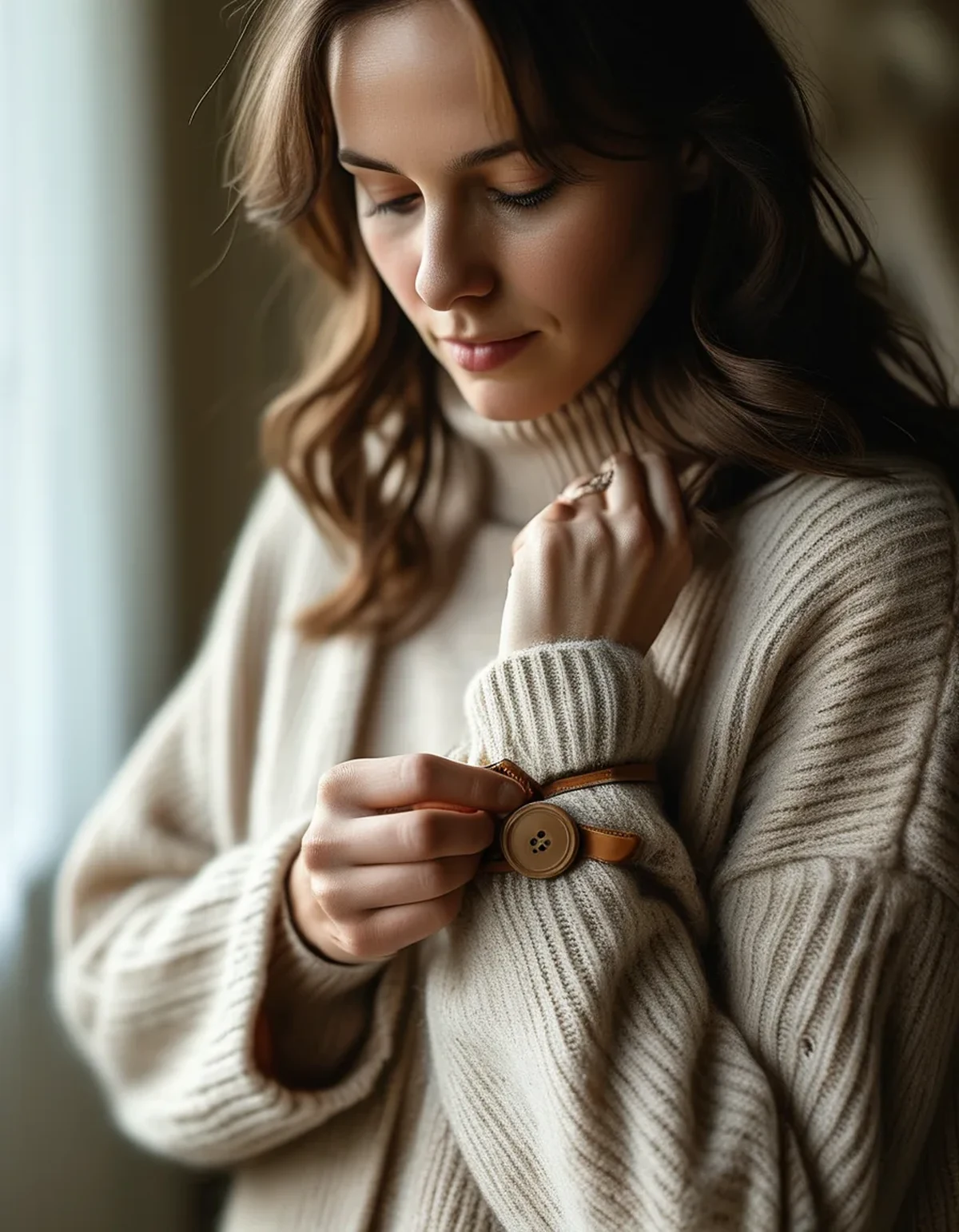
How do you tell a real horn button from plastic?
Four tests, and you can do the first three in a shop.
Look for variation. Horn and corozo are natural materials and no two buttons are identical. Slight differences in tone, faint striations, small imperfections — all good signs. A row of buttons that match perfectly is almost always moulded, because moulding is the only way to achieve that consistency cheaply.
Check the edge. Moulded plastic buttons come out of a two-part mould, which leaves a faint seam line around the rim. Run a fingernail around the edge; if you feel a ridge, it is plastic. Natural buttons are cut and polished, with no seam.
Feel the temperature. Horn and corozo feel cool and take a moment to warm to the hand. Polyester warms almost instantly. It is a crude test but a surprisingly reliable one.
Weight. Natural buttons are denser. Held in the palm, a horn button has a heft that a same-sized plastic one does not.
Corozo — vegetable ivory, made from a palm nut — is the one most people misidentify. It looks like plastic at a glance but takes dye unevenly in a way plastic never does, and that faint mottling is the giveaway.
Why does the way a button is sewn on matter?
Because attachment is a labour cost, and labour is the first thing cut.
Machine-attached buttons are stitched flat with a fast lock stitch, straight through four holes in a plain X or two parallel bars. They are fine on a shirt. On a coat or jacket they fail, because the button needs a shank — a small stem of thread lifting it away from the fabric — to allow room for the thickness of the buttonhole layer.
No shank on a heavy garment means strain, and strain means the button eventually pulls through the fabric and takes a piece of the coat with it.
Cross-stitching, where the thread is wrapped around the base of the button to build that stem, is a hand or semi-hand operation and it costs real money. Find it on a coat and you are looking at a garment made with a budget for finishing.
The other tell is the thread colour. Good makers match the thread to the button or the cloth deliberately. Mass production uses one thread across a whole run, which is why you will sometimes find white thread on a navy coat.
What does a spare button actually tell you?
More than it should, because supplying one is a decision nobody has to make.
A spare button sewn into a side seam or supplied in a small bag means the maker planned for the garment to be worn long enough to lose one. It is a signal of intended lifespan, and it costs the manufacturer real money at scale.
Two spares of different sizes — one for the front, one for the cuff — is a stronger signal still.
No spare at all on a wool coat is a red flag not because the button will fall off, but because of what it implies about every other invisible decision in that garment.
There is a related tell: whether the spare actually matches. On natural-material buttons the spare is often a slightly different tone, which — counterintuitively — confirms the material is natural. A perfectly matching spare on a set of supposedly horn buttons means they came out of the same mould.

Myth vs Fact: What Buttons Really Signal
Myth: Metal buttons mean quality. Fact: Metal buttons are cheap to produce and are used constantly on fast fashion outerwear. Plated base metal chips and discolours within a season. Solid brass or good horn both outlast it.
Myth: Working cuff buttonholes prove a jacket is well made. Fact: They prove the jacket was finished at a certain standard, but they also make sleeve alterations far more expensive. On a jacket you will need altered, working buttonholes are a cost, not a benefit.
Myth: More buttons means more construction. Fact: Button count is a design choice. A well-made single-button jacket is a better garment than a badly made double-breasted one.
Myth: You cannot upgrade buttons. Fact: Replacing plastic buttons with horn is the single cheapest way to make an inexpensive coat look considerably more expensive. A set of good buttons plus a tailor’s time costs less than most people expect, and it transforms a plain coat.
Which other details follow the same logic?
Buttons are the fastest check, but they belong to a family of tells — all in places customers do not look.
Buttonhole finishing. Look at the stitching around the hole itself. Dense, tight stitching that lies flat means a good machine and a slow setting. Loose, gappy stitching with visible fabric between the threads means speed.
Pocket bags. Turn a pocket out. Cotton or a decent lining fabric is a good sign; thin synthetic that you can see daylight through is not, and it is the first thing that tears.
Lining attachment. A hand-tacked lining hem, with a small fold of ease at the bottom, means the lining can move with the garment. A lining stitched flat and tight will split at the seam within a couple of seasons.
Pattern matching at the seams. On anything with a stripe, check whether the pattern lines up across the side seam. Matching wastes fabric, which is why it is one of the most expensive signals of all.
None of these appear on the label. All of them determine whether you still own the garment in five years.
FAQ: Quality Detail Questions, Answered
Is it worth replacing buttons on a cheap coat?
Yes — it is the best value upgrade in a wardrobe. Good horn or corozo buttons plus a tailor’s time transforms how an inexpensive wool coat reads, and it costs a fraction of the difference between price tiers.
Do designer garments always have good buttons?
No. Diffusion lines and licensed products frequently use moulded buttons on garments carrying a well-known name. The button test is more useful precisely because it ignores the label.
What is corozo and why does it keep coming up?
It is a button material made from the nut of the tagua palm, sometimes called vegetable ivory. It is hard, takes dye beautifully, is fully biodegradable, and sits between plastic and horn on cost. Finding it on a shirt is a strong sign the maker cared.
TL;DR:
- Buttons are honest because they are costed late and customers never check them.
- Look for natural variation, no mould seam, real weight, and cross-stitched shanks on heavy garments.
- A supplied spare button signals a garment designed to last.
- Upgrading buttons is the cheapest way to raise how a coat reads.
Go and look at the cuff of whatever coat is nearest to you. Whatever you find there is a more reliable account of that garment than anything printed on the label.
Keep Reading
This article is for general styling and informational purposes only. Trends, sizing, availability and pricing may vary by brand and season.