Why a Classic Outfit Needs One Thing That Is Slightly Too Big
Quick Answer: Classic pieces fitted correctly everywhere read as conservative rather than chic, because nothing in the outfit is a decision. Oversizing exactly one element — the shirt, the blazer, or the knit — introduces a proportion contrast that signals intent. The rule that keeps it from looking sloppy: everything else stays precisely fitted, and the oversized piece must be oversized in only one dimension.
You own good classic clothes. They fit. The outfit is correct and slightly forgettable, and you cannot work out what is missing.
What is missing is contrast, and there is a specific way to add it without losing the classic part.
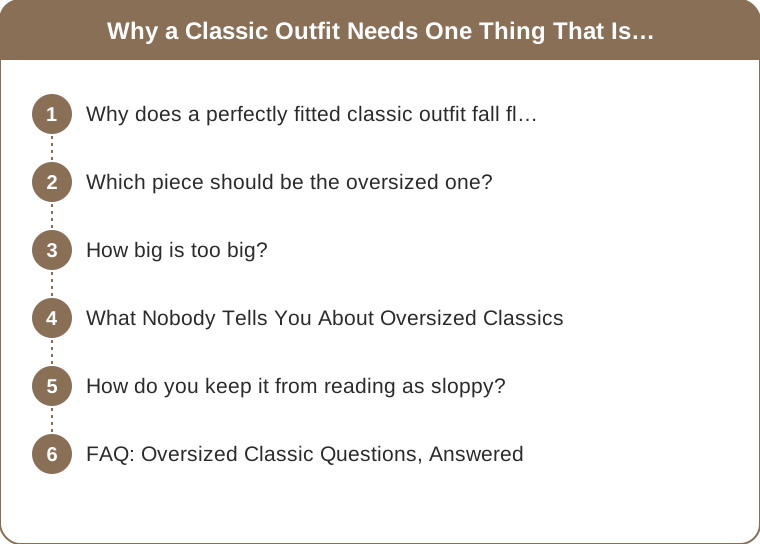
Why does a perfectly fitted classic outfit fall flat?
Because every piece is answering the same question the same way.
A well-fitted blazer over a well-fitted shirt over well-fitted trousers gives the eye a single, consistent proportion. Consistency reads as correctness, and correctness reads as a uniform — accurate, professional, and completely anonymous.
Chic requires a visible decision. Something in the outfit has to look like it was chosen rather than fitted, and proportion is the cheapest way to show that without adding color or print.
This is why the same four garments look different on two people. One person had them all tailored to the same standard; the other let one of them be big on purpose.
Which piece should be the oversized one?
The one closest to your face, or the one furthest from it. Not the middle.
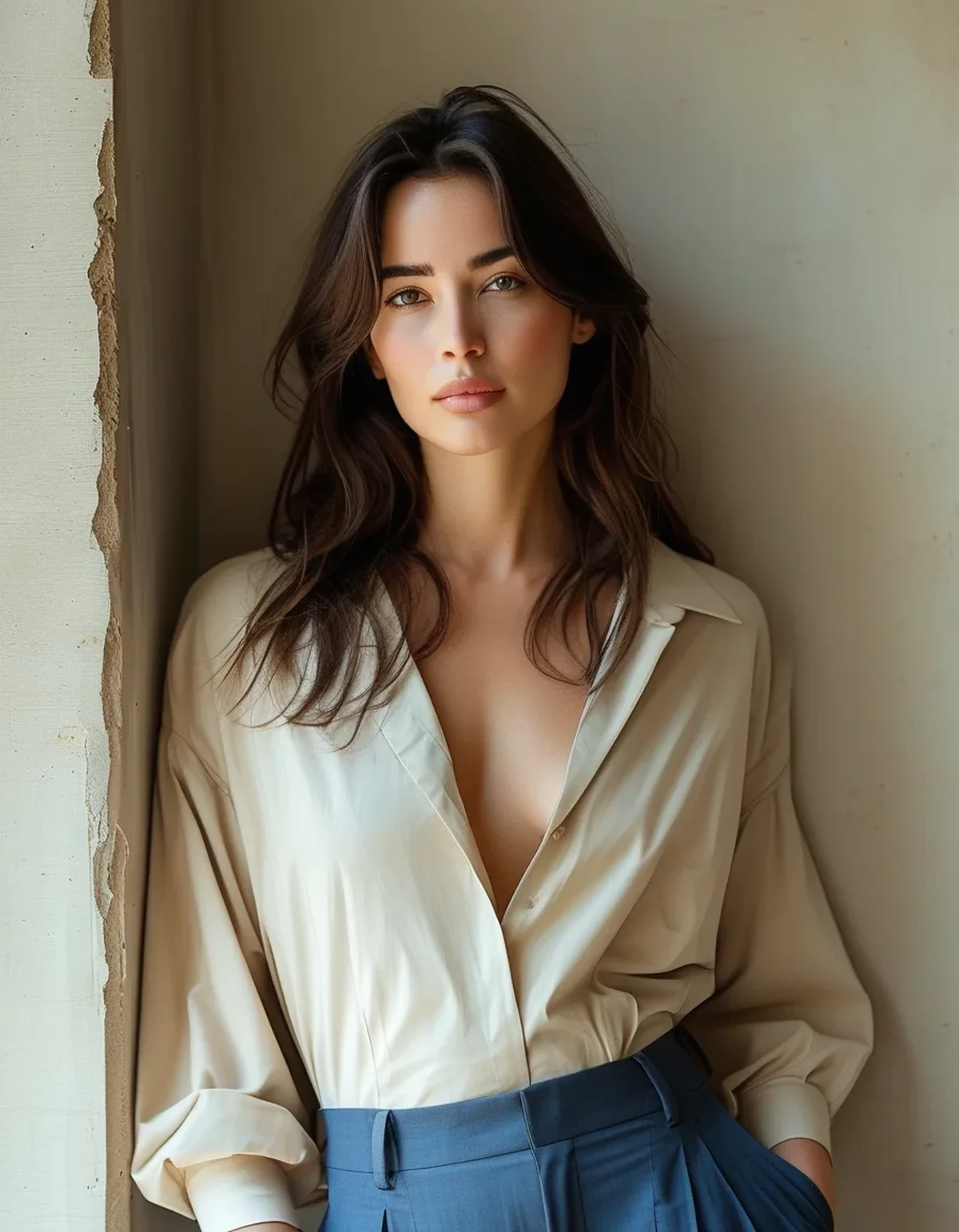
Oversizing the top layer — a blazer, a coat, an overshirt — is the safest and most flattering option. The volume sits away from the body, the fitted pieces underneath still define the silhouette, and the effect reads as confident rather than careless.
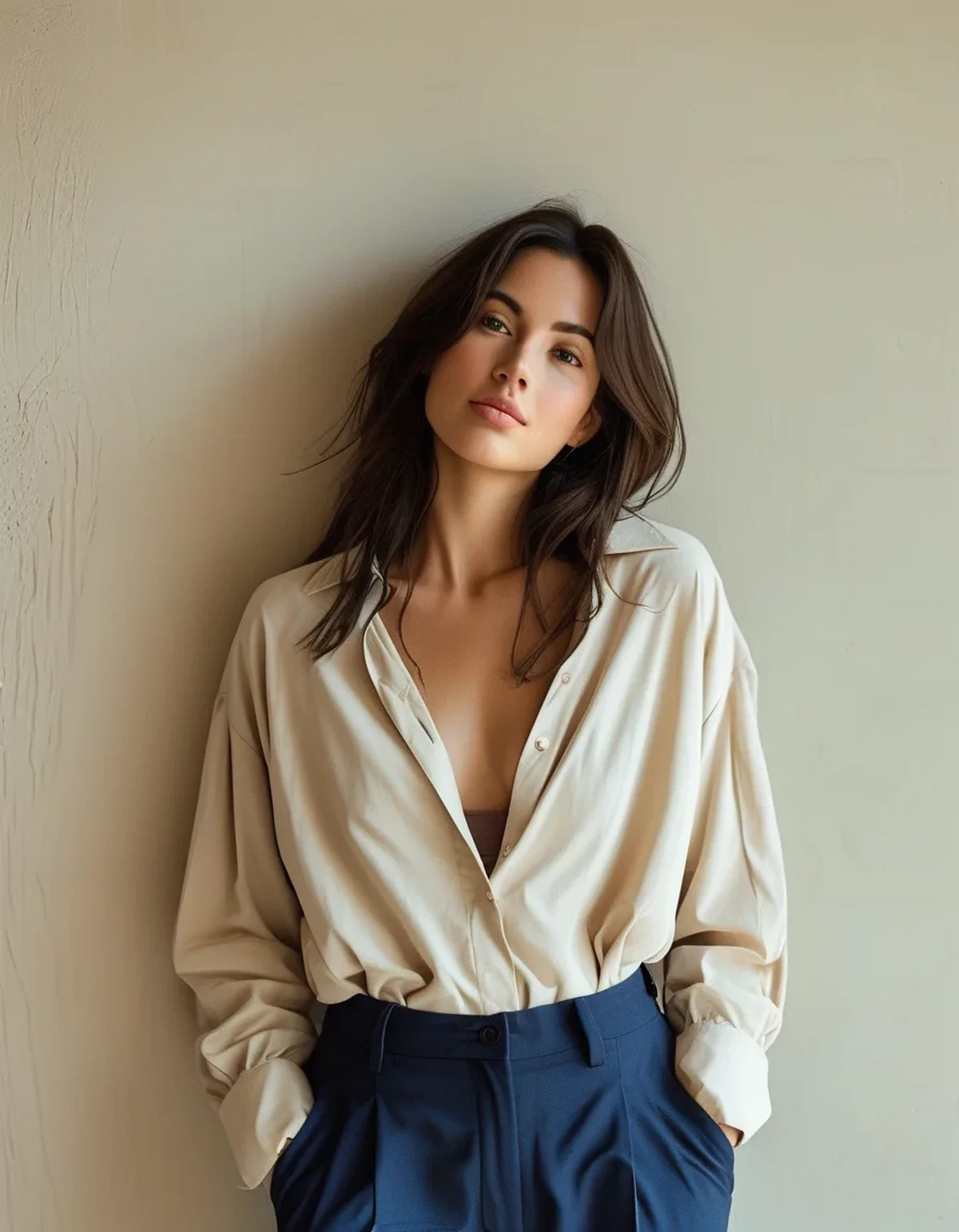
Oversizing the shirt underneath works when the outerwear is fitted. A large soft shirt tucked into narrow trousers under a precise blazer is a classic proportion play that has never stopped working.
Oversizing the trousers works only if the top half is genuinely snug. Wide trousers with a wide top is not contrast, it is just volume, and volume without contrast is where sloppy starts.
Never oversize two things. The moment there are two, the eye stops reading contrast and starts reading a size mistake.
How big is too big?
One dimension, not all of them, is the whole answer.
A good oversized piece is generous in width and correct in length. A shirt can be two sizes wide through the body and still hit at the right point on the hip; a blazer can have a dropped shoulder and still end where a fitted blazer would.
The moment length goes too, the eye reads borrowed rather than chosen. Sleeves past the knuckle, a hem below the hip on a shirt not meant to be a dress, a coat that swamps the shoe — those are the specific signals that read as a mistake.
The sleeve is the fastest tell and the fastest fix. Cuff an oversized sleeve to just above the wrist bone and a too-big shirt instantly becomes a styled one.
Rough measure: one to two sizes up in width, true size in length. Beyond two sizes, most garments lose their shoulder line entirely and there is nothing left to read as tailoring.
What Nobody Tells You About Oversized Classics
The fabric decides whether volume looks expensive. The same oversized shirt in crisp poplin reads architectural and in thin cotton reads like it shrank in the wrong direction. Volume needs either body or excellent drape, and the fabrics that fail are the ones in between.
An oversized piece needs a visible waist somewhere else. If the big shirt hides the waist and the trousers sit low, the silhouette disappears entirely. A high-rise trouser or a tuck restores the line for free.
Dark colors carry volume better than light ones. A large navy blazer reads as intentional; the identical cut in pale beige reads as bigger than it is, because light colors advance visually. If you are nervous about the whole idea, start in a dark neutral.
Shoulder seams tell the truth. On a deliberately oversized piece, the seam should sit clearly off the shoulder — an inch or more down the arm. A seam that sits half an inch off looks like the wrong size, because it is ambiguous. Commit or fit; the middle is what looks wrong.
Shoes anchor the whole thing. Volume on top with a slight, delicate shoe looks unbalanced. A loafer, a clean sneaker, or a boot gives the outfit something to stand on.
How do you keep it from reading as sloppy?
Everything that is not the oversized piece gets stricter, not looser.
Tuck something. A front tuck or a full tuck at the waistband is the single most effective anti-slop move, because it proves the volume was a choice by showing you know where your waist is.
Keep the palette tight. One oversized element plus three colors is a lot of information. One oversized element in a two-color outfit is a styling decision and reads instantly as deliberate.
Make sure the grooming and the accessories are precise. A big blazer with a considered necklace and a clean shoe is chic. The same blazer with nothing else considered is a big blazer.
Press the oversized piece. Volume and wrinkles together read as unmade. Volume with a crisp finish reads as design.
FAQ: Oversized Classic Questions, Answered
Does this work on a petite frame?
Yes, with the length rule enforced strictly. Width can be generous at any height; length is where petite frames get swallowed. Buy the oversized width in a petite length if it exists, or have the hem and sleeve adjusted.
Can the oversized piece be knitwear?
It is one of the best options, provided the gauge is fine enough to drape. A chunky oversized knit adds volume in every dimension at once, which is the thing to avoid; a fine-gauge oversized knit adds width only.
What if I want the outfit to read professional?
Oversize the blazer and keep everything else precisely fitted and in a dark neutral. That combination reads current and authoritative at the same time, and it is common in every office where people dress well.
How do I know if it is working?
Take a photo from six feet away. If you can identify one clearly larger piece and everything else looks deliberate, it is working. If two things look large, take one of them off.
TL;DR: Classic done perfectly is correct. Classic with one thing deliberately too big is chic.
- Everything fitted equals a uniform. Contrast is what reads as a decision.
- Oversize the top layer for the safest version, or the shirt under a fitted jacket.
- One to two sizes wide, true length. Length is what makes it look borrowed.
- Never oversize two pieces. Two reads as a sizing error.
- Tuck something and keep the palette to two colors.
- Press it. Volume plus wrinkles is the only real failure mode.
Try it with the shirt you already have that runs large. Tuck the front, cuff the sleeve above the wrist, and see how differently the same trousers read.
Keep Reading
This article is for general styling and informational purposes only. Trends, sizing, availability and pricing may vary by brand and season.