Dry Cleaning Is Aging Your Classics Faster Than Wearing Them
Quick Answer: Dry cleaning uses solvent, heat, and mechanical agitation, and all three strip the natural oils that give wool its bounce and its depth of color. A tailored piece can take perhaps 15 to 25 cleans before the hand of the cloth visibly changes. Clean a blazer twice a season, not twice a month — spot-clean, brush, and air it instead, and the same piece lasts years longer.
There is a particular kind of care that ruins things. You buy the good coat, you look after it properly, you take it in after every few wears — and four years later it has gone thin and slightly grey in a way you cannot quite name.
It was not the wearing.

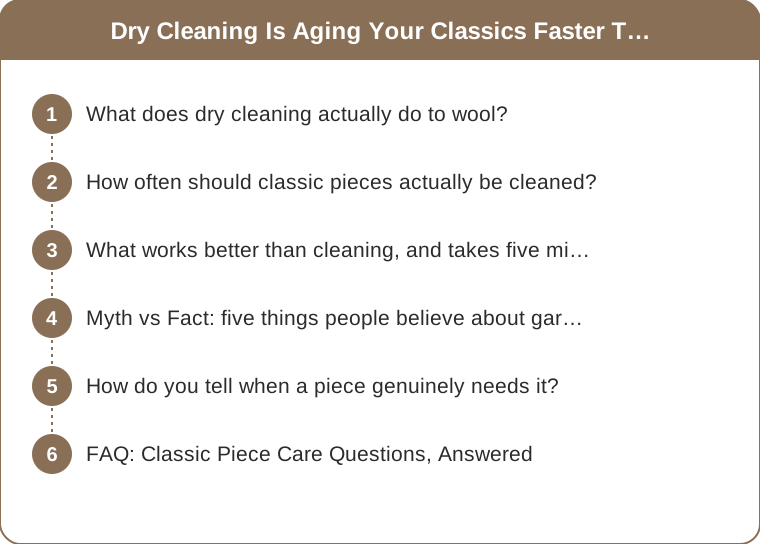
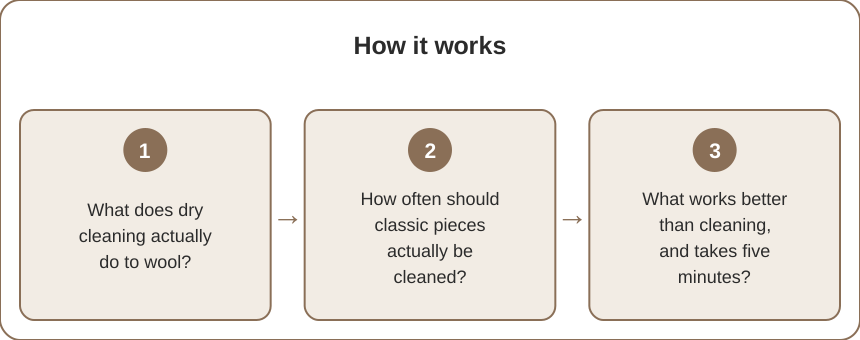
What does dry cleaning actually do to wool?
It is not dry, for a start. The garment is immersed in a liquid solvent — usually perchloroethylene or a hydrocarbon substitute — tumbled to loosen soil, then pressed with heat and steam.
Each of those steps costs the cloth something.
The solvent removes lanolin and the natural oils in the fibre along with the dirt. Those oils are what let a wool fibre bend and spring back. Strip enough of them and the fibre starts to crease rather than recover, which is why a heavily cleaned blazer holds elbow creases it used to shake out overnight.
The tumbling is mechanical stress. Gentler than a washing machine, not gentle. It works loose the stitching at high-tension points — armholes, the collar stand, pocket corners.
The press is heat on the surface. Repeated pressing flattens the raised nap of woollen cloth, which is exactly the texture that makes a good coat look expensive. Once flattened, it reads shiny at the seat and shoulders, and it does not come back.
None of this makes dry cleaning wrong. It makes it a procedure with a cost, to be spent when it is worth spending.
How often should classic pieces actually be cleaned?
Far less often than most people assume. Rough guides for pieces in normal rotation:
- Tailored blazer or coat: once or twice a season, or when visibly soiled. Some tailors will say once a year.
- Wool trousers: every 4 to 5 wears if they touch a chair all day, less otherwise. Trousers genuinely do need it more than jackets — they sit against more of you.
- Knitwear: almost never. Hand-wash cool or use a gentle wool cycle. Dry cleaning cashmere is one of the fastest ways to flatten it.
- Trench in cotton gabardine: once a season at most. Frequent cleaning strips the water-resistant finish, which is the point of the coat.
- Silk blouses: after every 2 to 3 wears, because body oils yellow silk permanently if left. This is the exception where waiting costs more than cleaning.
The question to ask before booking is not have I worn this several times. It is can I see or smell a reason. If not, the piece wants airing, not solvent.
What works better than cleaning, and takes five minutes?
The traditional care routine exists because it works, and it has been quietly abandoned in the last thirty years.
Brush after every wear. A soft bristle clothes brush, ten seconds per panel, downward strokes. It lifts out the dust and grit that would otherwise work into the weave and abrade the fibres from the inside. This single habit does more for a coat’s lifespan than any cleaning schedule.
Air for 24 hours before it goes back. Hang the piece outside the wardrobe, ideally near an open window, on a broad wooden hanger. Wool is remarkable at releasing odour on its own — most of what sends people to the cleaner disappears overnight.
Spot-clean immediately, with water first. For most fresh marks, a barely damp cloth blotted — never rubbed — from the outside of the stain inward will lift it. Rubbing pushes the mark into the weave and disturbs the nap.
Steam rather than press. Ten seconds of steam held 15cm away relaxes creases without flattening the nap. Do this instead of asking the cleaner to press.
Rest the piece. Wool needs roughly 24 hours to recover its shape. A blazer worn Monday and Tuesday is being worn twice as hard as one worn Monday and Thursday, and it will show it within a year.

Myth vs Fact: five things people believe about garment care
Myth: Dry cleaning is the gentle option for delicate pieces. Fact: It is gentler than machine washing and harsher than doing nothing. For unsoiled wool, doing nothing genuinely wins.
Myth: A piece should be cleaned before it goes into storage. Fact: This one is true and worth following. Moths are drawn to body oils and food traces, not to clean wool. Store clean, wear dirty is the correct order — and it is the reverse of what most people do.
Myth: The plastic bag from the cleaner protects the garment. Fact: It traps residual solvent and moisture against the cloth and can yellow it. Take it off the moment you get home. This is the most common mistake on this list and the easiest one to stop making.
Myth: More expensive cleaning is gentler. Fact: What you are buying at a good cleaner is careful handling, correct pressing, and honest advice about whether a piece needs it. Those are real, but they do not change what the solvent does.
Myth: If it looks fine after cleaning, no damage occurred. Fact: The change is cumulative and invisible per visit. It shows up around clean 20, as a loss of bounce that nobody can trace back to a cause.
How do you tell when a piece genuinely needs it?
Four honest triggers, and nothing else:
A visible mark that spot-cleaning did not lift. Not a mark you can only find by looking for it.
Odour that survives 24 hours of airing. Smoke and cooking smells do bind to wool and will not leave on their own.
Loss of shape from moisture. A coat caught in heavy rain and dried unevenly benefits from a professional press. This is the case where the cleaner is repairing rather than maintaining.
Before long storage. End of season, going into a bag or a cedar chest. Clean once, properly, then leave it alone.
Outside those four, the honest answer is that the piece wants a brush and a day off. The wardrobes that look best over a decade are not the best maintained — they are the least over-maintained, and the difference is mostly restraint.
FAQ: Classic Piece Care Questions, Answered
Can you wash a wool blazer at home?
Not a structured one. The canvas, shoulder padding, and lining shrink at different rates, and the shape does not survive it. Unstructured, unlined blazers in wool or linen can sometimes be hand-washed cool and dried flat — check for a canvas layer by pinching the lapel and feeling for a third layer between face and lining.
Is eco or wet cleaning better for classics?
Professional wet cleaning is gentler on the nap and does not strip oils as aggressively, but it carries a shrinkage risk on tailored pieces. It is a good choice for unstructured garments and a conversation to have with the cleaner for structured ones.
How do you get rid of shine on a jacket seat or elbows?
Light shine can be reduced by steaming and brushing the nap back up while damp. Set shine from repeated hot pressing is permanent — which is the whole argument for steaming at home rather than asking for a press.
Does a clothes brush really make a difference?
More than any product you can buy. Grit trapped in the weave acts as an abrasive every time the fabric flexes, so brushing removes wear that is happening whether the piece looks dirty or not.
TL;DR:
- Dry cleaning strips the natural oils that let wool spring back, and repeated pressing flattens the nap permanently.
- Clean a blazer once or twice a season, trousers every 4 to 5 wears, knitwear almost never, silk more often than either.
- Brush after every wear, air for 24 hours, steam instead of pressing, and rest a piece a day between wears.
- Clean before storage, not before wearing — moths follow body oils, not clean wool.
- Take the plastic bag off the moment you get home; it traps solvent against the cloth.
Good clothes do not need much. They need the right five minutes, repeated — which is a far cheaper habit than the one most of us have.
Keep Reading
This article is for general styling and informational purposes only. Trends, sizing, availability and pricing may vary by brand and season.