Why Good Cashmere Pills and Cheap Cashmere Often Does Not
Quick Answer: Pilling is caused by short fibres working loose and tangling at the surface, and the finest cashmere is made of exactly those short, soft fibres. A sweater that never pills is usually one blended with nylon or spun from longer, coarser, cheaper hair. So a light pill in the first few wears is normal, sometimes even a good sign. What matters is whether it stops after the first season or keeps going forever.
Every autumn someone pulls a cashmere sweater out of storage, finds a constellation of tiny bobbles under the arms, and concludes they were sold something fake. Nine times out of ten they were not. They were sold something soft, and softness and pilling come from the same place.


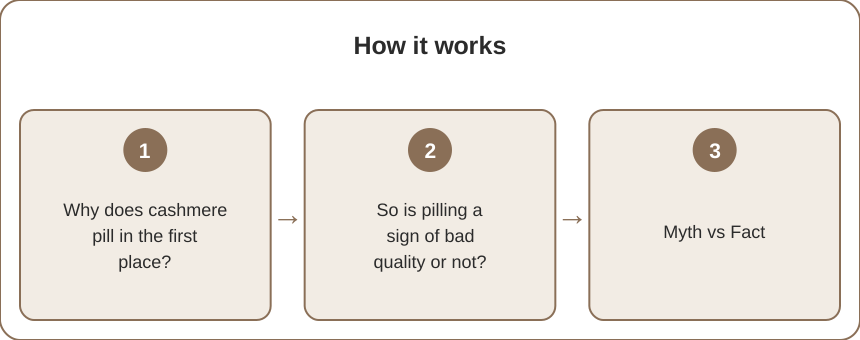
Why does cashmere pill in the first place?
A cashmere yarn is not one continuous thread. It is thousands of short hairs, each somewhere between 32 and 42 millimetres long, twisted together so friction holds them in place.
When you wear the sweater, friction at the contact points — underarms, the inside of the sleeve where it rubs your coat, the line where a shoulder bag sits — teases the ends of those short hairs out of the twist. Loose ends tangle with each other, and a tangle that has nowhere to go rolls itself into a ball. That ball is a pill.
Here is the part that surprises people: fineness makes it worse. Grade A cashmere is prized for hairs around 14 to 15.5 microns thick. Thinner hairs are softer against the skin and also weaker, more flexible, and far more willing to slip out of the twist and knot up. The exact property you paid for is the property that produces bobbles.
Meanwhile a sweater blended with 10 percent nylon barely pills at all. Nylon filament is long, smooth, and strong, and it locks the short cashmere fibres in place like rebar. It is a genuinely sensible construction. It is also, unmistakably, less soft.
So is pilling a sign of bad quality or not?
It is a sign of short fibres. Whether that is good or bad depends on why they are short.
Short because the fibre is fine. This is the good version. The hair came from the undercoat of a goat in a cold climate, it is thin, and it is soft. It will pill lightly for the first several wears and then largely settle down, because the loose ends work themselves out and what remains is a stable surface.
Short because the fibre is broken. This is the bad version. Recycled or heavily processed cashmere, or hair that has been aggressively de-haired and dyed, arrives at the spinner already damaged. Those fragments never settle. The sweater pills in week one, in month six, and in year two, and each de-pilling session removes real material until the knit goes thin and translucent at the elbow.
The test is time, not the first week. A good sweater pills, you shave it once or twice, and then it mostly stops. A bad one keeps producing bobbles at the same rate forever. If you want a single question to ask yourself in month three, it is not did this pill but is it still pilling.
Myth vs Fact: Five Things People Believe About Cashmere
Myth: Two-ply is always better than one-ply. Fact: Ply is a thickness and durability spec, not a quality grade. A two-ply sweater has two strands twisted together, so it is warmer and holds shape better — genuinely useful in a coat-weather knit. But a one-ply made from excellent fibre beats a two-ply made from poor fibre, and plenty of beautiful lightweight sweaters are single-ply on purpose.
Myth: If it is very soft in the shop, it is very good. Fact: Shop softness can be borrowed. Heavy washing and chemical or mechanical softening make mediocre cashmere feel wonderful on the rack, and that finish washes out within a few launderings. Squeeze a handful and let go — good cashmere springs back and looks unbothered. Over-finished cashmere stays crushed.
Myth: The price tag tells you. Fact: It correlates loosely and no more. You are also paying for brand, margin, and where it was knitted. A mid-price sweater from a mill that buys well can outperform a designer piece by a wide margin.
Myth: Pilling means it is not real cashmere. Fact: Almost the reverse, as above. The pure fibre pills more than the blend does.
Myth: Dry cleaning is the safe option. Fact: Solvent strips the natural oils that keep the hair flexible, and every trip makes the next pill worse. Hand washing is gentler and, done properly, leaves the sweater softer than when it went in.

How do you tell good cashmere from bad before you buy it?
Four checks, none of which take more than ten seconds at the rack.
The stretch and release. Pull a section of the knit gently sideways and let go. It should recover almost completely. If a slack, wavy line stays behind, the yarn is weak and the sweater will lose its shape at the cuffs and hem within a season.
The light test. Hold it up to a window. You are looking for an even, dense field. Thin patches and visible gaps mean a loosely knitted fabric, which is where manufacturers save money most invisibly — the same weight of yarn spread over more square centimetres.
The rub. Rub two layers of the fabric against each other briskly with your palm for five seconds. A little fuzz is fine and expected. A visible bobble forming in five seconds is a preview of your entire ownership.
The weight in the hand. Pick up two sweaters of similar size. Density is the honest luxury signal, and it is the one that photographs least well online, which is exactly why it survives as a tell in a physical shop.
And read the label for what is not there. Ply, gauge, and country of knitting listed openly suggest a maker who expects the specs to help them.
How should you actually care for it?
The care routine matters more than the purchase, because most cashmere is destroyed by handling rather than by wear.
Wash it, do not dry clean it. Cool water, a capful of a gentle wool wash or baby shampoo, ten minutes of soaking, and light squeezing rather than wringing. Rinse cool, press the water out between two towels, then dry flat and reshape by hand. It comes out softer, and you have not stripped the oils.
Wash it more often than feels right. Body oils and skin cells lubricate friction and attract moths. Every three to four wears is the sweet spot for a piece worn against the skin.
De-pill with a razor or a comb, not your fingers. A cheap cashmere comb or a clean disposable razor drawn flat across the surface takes the bobble off cleanly. Picking at pills pulls the anchoring fibre out with them and thins the knit.
Fold, never hang. A hanger loads the entire weight of the garment onto two points at the shoulder, and knitwear has no structure to resist that. You get elongated shoulders and a hem that hangs crooked, and neither is fixable.
Rest it between wears. Twenty-four hours flat lets the fibres recover their loft. A sweater worn two days running looks tired by the second afternoon, and that tiredness eventually becomes permanent.
FAQ: Cashmere Questions, Answered
How many times can I de-pill a sweater before I ruin it?
A good one, indefinitely — because a good one mostly stops pilling after the first season and you end up shaving it once or twice a year. A poor one is a different story: each pass removes fibre, and after five or six sessions you will see the knit thinning where you shave most. If you are de-pilling monthly in year one, the sweater is telling you something.
Is a cashmere blend a downgrade?
Not necessarily. Cashmere with 5 to 10 percent silk or nylon is more durable, holds its shape better, and pills far less, at the cost of some softness and warmth. For a sweater you will wear under a coat twice a week all winter, the blend is often the smarter buy. Save the pure two-ply for the pieces worn closest to the skin.
Why does my sweater pill in one spot and nowhere else?
Because pilling is friction, and friction is local. The usual culprits are a shoulder bag strap, the inside of a coat sleeve, and a seatbelt. Switching your bag to the other shoulder or wearing a scarf under the strap solves more pilling problems than any change of detergent will.
TL;DR:
- Pilling comes from short fibres working loose, and the finest, softest cashmere is made of short fibres — so a light pill early on is normal.
- The real quality signal is whether it stops. Good cashmere settles after a season; poor cashmere pills forever and thins as you shave it.
- Check the stretch recovery, the density against the light, and a five-second rub before you buy. Ply and price tell you far less.
- Hand wash in cool water, dry flat, fold rather than hang, and rest it a day between wears.
The frustrating truth is that the sweater which never bobbles is usually the one with nylon holding it together, and the one that bobbles in week two may well be the better piece of knitwear. Shave it, wash it kindly, and judge it in March.
Keep Reading
This article is for general styling and informational purposes only. Trends, sizing, availability and pricing may vary by brand and season.