Why Pocket Placement Decides Whether a Coat Looks Expensive
Quick Answer: Pocket placement sets a horizontal line across the hip and controls where the eye stops on a coat, so a pocket placed too low shortens the leg and one placed too high widens the hip. The quality tells are the finish and the angle rather than the style: a welt or besom pocket with a clean, flat opening reads expensive, a patch pocket sewn slightly crooked reads cheap instantly, and a pocket that gapes open when you stand still means the coat was cut without enough room through the hip.
You try on two coats at the same price in the same fabric, and one of them looks considerably better than the other without any obvious reason. The shoulder is fine on both. The length is similar. Nine times out of ten the difference is sitting at hip height, and once you have seen it you cannot unsee it.

What does pocket height actually do to the proportions?
It creates a horizontal, and horizontals divide.
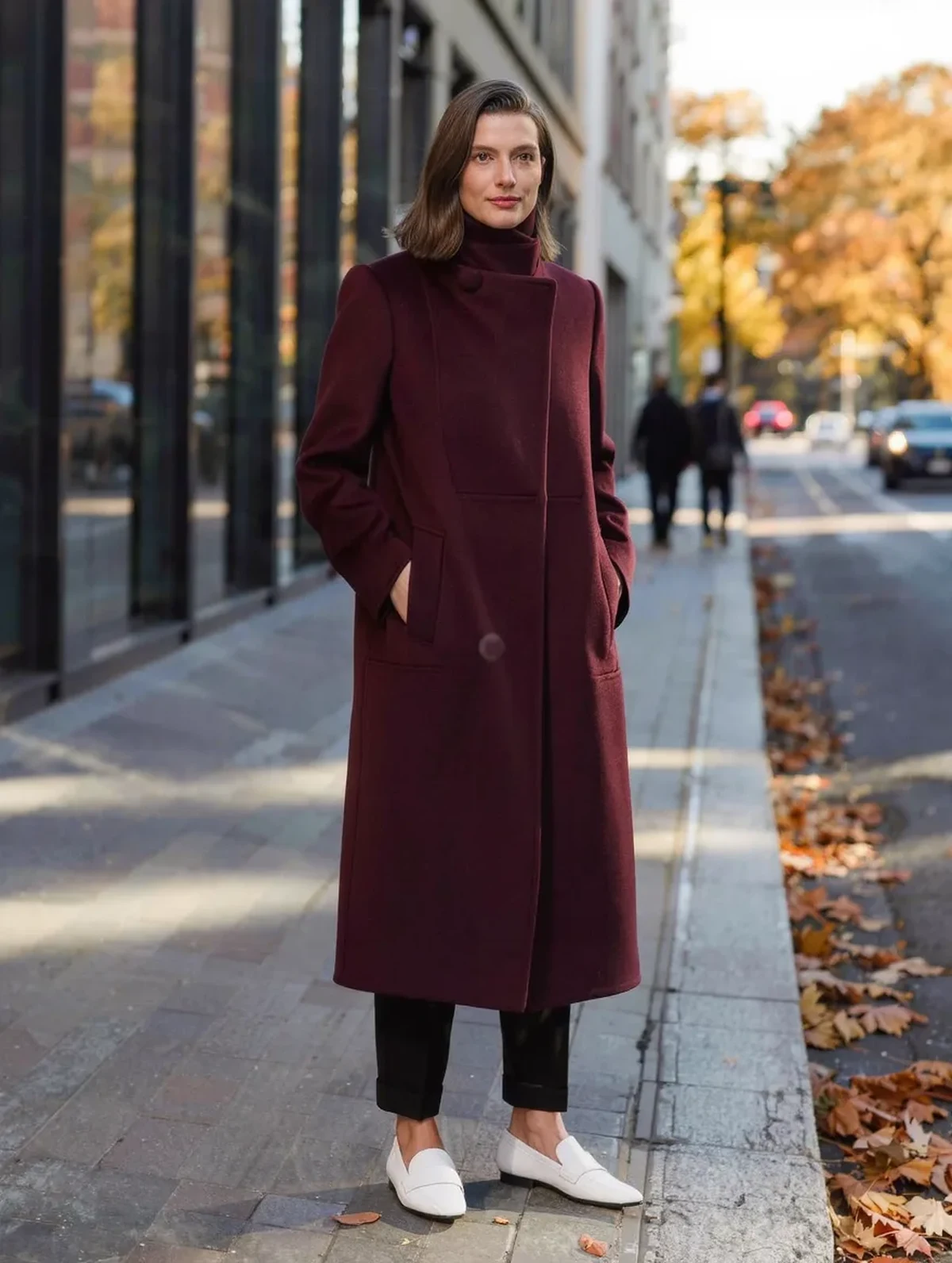
On a coat, the pocket line is usually the strongest horizontal below the shoulder, especially when it is a patch pocket with a visible edge. The eye reads that line as the point where the torso ends and the leg begins, regardless of where your actual hip is.
So a pocket set low — below the natural hip — visually shortens the leg and lengthens the body. This is the most common flaw in inexpensive outerwear, because pocket position is often set by where the lining panels happen to join rather than by proportion.
A pocket set slightly above the widest point of the hip does the opposite: it raises the division and lengthens the leg. Classic tailoring usually places it just above the hip bone, angled very slightly forward, which both flatters and makes the pocket usable without twisting your wrist.
And the angle matters as much as the height. A slanted pocket follows the line of the hip and disappears into the shape of the coat. A dead-horizontal pocket cuts across it and emphasises width. On a straight coat, horizontal is fine. On anything with a curve through the hip, a slant almost always reads better.
Which pocket types signal quality, and which do not?
The style is not the tell — the execution is. But some styles are harder to fake.
Welt and besom pockets are cut into the fabric and finished with a narrow lip. They require the maker to cut a hole in an expensive panel and finish it precisely, and there is nowhere to hide an error. When these are clean, flat and symmetrical, you are looking at real construction.
Flap pockets are a welt pocket with a flap over it. The tell is whether the flap lies flat or pops outward. A flap that stands away from the coat usually means the pocket bag underneath is bulky or the coat is tight through the hip.
Patch pockets are sewn onto the surface. They are the easiest to make and the most common on both very cheap coats and very expensive relaxed ones — so judge them by whether the two sides match exactly in height and angle, and whether the pattern of the fabric continues across them. On a check or herringbone coat, a good patch pocket matches the pattern so precisely it nearly vanishes. A mismatched one is visible from ten metres.
Inseam pockets, hidden in a side seam, are the most discreet and often appear on quiet, well-made coats. The tell is whether the seam puckers where the opening is.
And any pocket still stitched shut on a coat you have owned for a year is a sign it was never worth opening — but do not cut them open in the shop, because the stitching is holding the shape until the coat has settled.
What Nobody Tells You About Coat Pockets
A gaping pocket means the coat is too small, not that the pocket is badly made. Welt pockets sit flat when there is enough ease through the hip. If they pull open while you stand still with your arms down, size up — no alteration fixes this.
The pocket bag fabric tells you the budget. Reach inside. A cotton or blended twill bag that feels substantial is a sign of a coat built to survive keys and phones. A thin, slippery synthetic bag will wear through within two winters, and repairing it costs more than most people expect.
Hands in pockets is the real fit test. Put both hands in, naturally. If the coat pulls across the back, or the shoulders lift, the sleeve or the back is cut too narrow — and since this is how a coat is actually worn on a cold street, it matters far more than how it looks with arms at the sides.
Pockets change shape permanently. A phone carried in the same pocket every day will stretch the opening and drop the corner, and on a wool coat that sag never comes back. This is the single most common way a good coat starts to look worn out while the fabric is still perfect.
And the interior pocket is a quality signal in itself. A well-made coat has at least one, usually on the left, usually with a reinforced opening. Its absence does not make a coat bad, but its presence is rarely found on the cheap ones.
How do you check pockets in about thirty seconds in a shop?
Stand square in front of a mirror and find the line. Where does the pocket line sit relative to your hip and your wrist? A pocket at natural wrist height is comfortable and usually well-proportioned. Well below the wrist is a proportion problem you will notice every time you see a photograph of yourself.
Check symmetry by eye, not by measuring. Look at both pockets together and let them be slightly out of focus. Asymmetry announces itself immediately at a glance and is almost invisible when you stare at one side.
Put your hands in, then take them out and look. Does the opening lie flat again, or does it stay gaping? Good pockets recover. Poor ones keep the shape of your hands.
Feel the bag. Thin and slippery is a future repair.
Then step back three metres. At conversational distance, a coat is mostly shoulders, length and the pocket line. If that line looks low or heavy from across the room, no amount of styling will correct it — and that is the one flaw worth walking away from, because everything else on a coat can be adjusted.
FAQ: Coat Pocket Questions, Answered
Should I unpick the stitching that holds pockets closed?
Yes, once you are keeping the coat — that stitching is for shipping and display. Use a seam ripper, not scissors, and work from the inside. On a coat you plan to wear rarely and keep pristine, leaving them shut genuinely helps the line stay crisp.
Can a tailor move a pocket that sits too low?
Almost never on a welt pocket, because it would leave a hole in the face fabric. A patch pocket can sometimes be moved, but the old stitch marks usually show on wool. Treat pocket position as a fixed property of the coat and decide before you buy.
Is a coat without exterior pockets a bad sign?
No — some designs deliberately omit them for a clean line, and it is common in dressier styles. Check that there is an inseam or interior pocket somewhere, and be honest about whether you will actually wear a coat you cannot put your hands in during the coldest three months of the year.
TL;DR:
- The pocket line is the strongest horizontal below the shoulder, so a low pocket shortens the leg and a slightly high, slanted one lengthens it.
- Judge execution rather than style: clean welts, matching patch pockets on a pattern, and openings that lie flat again after use.
- A gaping pocket means the coat is too tight through the hip, and no alteration fixes it.
- Check the pocket bag fabric, put both hands in to test the cut, and assess the line from three metres away.
Pockets are the part of a coat people look at last and see first. They are also one of the few flaws that cannot be tailored away, which makes thirty seconds of checking in the shop worth considerably more than it sounds.
Keep Reading
This article is for general styling and informational purposes only. Trends, sizing, availability and pricing may vary by brand and season.